 Adawat
How to Teach Your Child to Write Arabic Letters
3 min readBy The Adawat team
The easiest way to teach a child to write Arabic letters is a few minutes a day: look at the letter, say its sound, trace it, then write it alone. Printable tracing sheets from the Arabic letter worksheets give you the guides, and you supply the routine and the encouragement.
This guide explains how to plan the sessions, why the four letter forms matter, and how to keep practice playful. It works for children who are starting school and for older learners of Arabic as a second language.
Steps
You need a printer or a notebook, a soft pencil and a quiet table. Sessions of five to ten minutes are enough for young children.
- 1
Start with the sound and the name
Say the letter name and its sound, then a simple word that starts with it, such as أسد for alif. A child who can hear the letter finds it easier to write it.
- 2
Print a tracing sheet for one letter
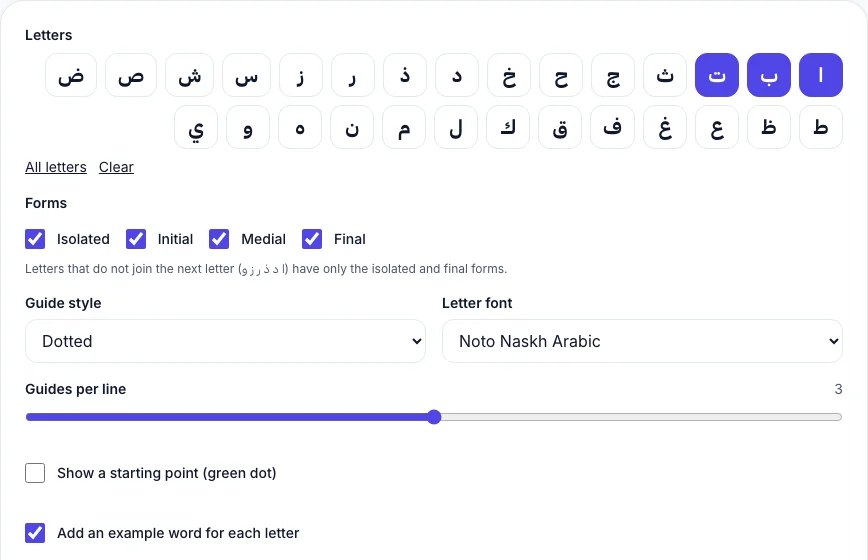
Open the Arabic letter tracing worksheets, choose a single letter and print its isolated form with an example word. One letter per session keeps the task small and the success real.
- 3
Trace with a finger first
Before using a pencil, let the child run a finger along the dotted letter, starting at the green point if you have shown it. The movement teaches the shape before the hand has to control a pencil.
- 4
Write over the dots, then alone
Ask the child to write over the dotted copies and then on the empty line. Praise effort and neat starts rather than perfect shapes, and stop before the child is tired.
- 5
Add the other forms gradually
Once the isolated letter is easy, add the initial, medial and final forms. Remember that alif, dal, thal, ra, zay and waw have only two forms because they do not connect to the next letter.
- 6
Review with cards and games
Make a small deck with the flashcard maker: the letter on one side and a picture or word on the other. Play a matching game, or let the child choose three cards to trace today.
- 7
Move on to words
When several letters feel comfortable, trace short words made of them. Writing a name, a family member or a favorite animal turns practice into something meaningful.
Why the four forms matter
In Arabic a letter changes shape inside a word. The letter baa looks different alone, at the start, in the middle and at the end, and children meet all four forms in their first books. Practising them early, in that order, helps reading as well as writing, because the child learns that the shapes belong to the same letter.
Handwriting methods differ between schools, especially in where a letter starts and how many strokes it takes. Treat any starting point on a worksheet as a suggestion and follow your child’s teacher if the method is different.
Common problems
My child loses interest after a minute
Shorten the session to one line and add a game, such as tracing with a colored pencil or finding the letter in a picture book.
The child writes the letter backwards or upside down
Show the starting point and the direction with your finger, and have them trace with a finger before the pencil. Arabic is written from right to left, which feels new at first.
Letters look different from the school book
Fonts vary. The worksheets use a clear Naskh style; if the school book uses another style, explain that both are the same letter.
The child presses too hard
Use a soft pencil and a thicker sheet, and have the child shake out their hand between lines.
Frequently asked questions
At what age can a child start writing Arabic letters?
Many children begin tracing around age four or five, once they can hold a pencil comfortably. Younger children can trace in sand or with a finger.
Which letters should we start with?
Many teachers start with alif, baa and taa, because their shapes are simple. Follow the order of your child’s school book if there is one.
Are the worksheets free to print?
Yes. Choose the letters, download the PDF and print as many copies as you like, with no watermark and no sign-up.