 Adawat
Arabic letter tracing worksheets
Choose the letters and their forms and print dotted guides for children to trace, with a row of practice space after each one.
Your worksheets are made on your device
Nothing is uploaded. Names you type in the header are used only to draw the PDF.
Page and header
Next, try one of these tools
How to use
- 1Choose the letters to practise, or select all 28.
- 2Choose the forms: isolated, initial, medial and final. Letters that do not connect forward have only the forms they really use.
- 3Pick the guide style and, if you like, add starting points and an example word for each letter.
- 4Preview the pages, then download the PDF or print it.
Common uses
A new letter each week
Choose one letter with all its forms and an example word for a focused weekly sheet.
Reception and first grade
Print isolated forms of several letters with faint guides for the first month of writing.
Connecting letters
Switch on the initial, medial and final forms so children see how a letter joins its neighbours.
Learning Arabic as a second language
Give learners sheets of the whole alphabet with example words to read aloud.
Tips and limits
- Begin with isolated forms, and add the initial, medial and final forms once the child can write the letter alone.
- Dotted guides suit beginners; switch to faint letters or outlines when they need less support.
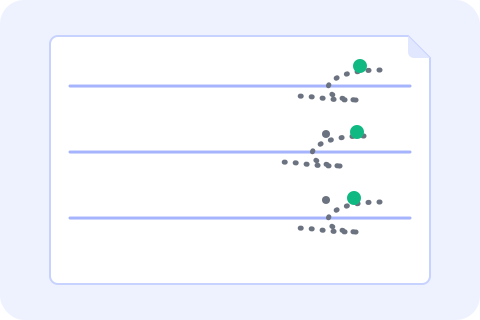
- The green starting points are approximate. Where your school’s handwriting method differs, follow the school and ignore the dot.
- Print on slightly thicker paper if children press hard, and let them use a soft pencil first.
Arabic letters, in every form they are written
An Arabic letter is not one shape: it changes depending on whether it stands alone or sits at the start, middle or end of a word. Children learn to write all of them, and a good tracing sheet shows each form that really exists. This generator draws dotted guides for the letters you choose, in the isolated, initial, medial and final forms, each followed by empty practice space on guide lines. The font is a clear Naskh style, large enough for small hands.
Six letters, alif, dal, thal, ra, zay and waw, never connect to the letter after them, so they have no separate initial or medial shape and the sheet shows them only in the forms they truly have. You can add a small green starting point, an example word for each letter that begins with it, and choose between dotted, dashed, outline and faint-letter guides. Pair the sheets with flashcards of the letters, move on to English letter tracing, or build number fluency with the multiplication worksheets.
For a gentle routine at home, read how to teach Arabic letters at home.
Step-by-step guides
Frequently asked questions
Which letter forms does the sheet show?
Isolated, initial, medial and final. Letters that do not join the next letter show only isolated and final forms.
Why do alif, dal, thal, ra, zay and waw have fewer forms?
They never connect to the following letter, so at the start of a word they look like their isolated form and in the middle like their final form.
Are the example words suitable for children?
Yes. Each is a simple, common word that begins with its letter, such as a lion for alif and a duck for baa.
Can I choose the font?
You can choose between Noto Naskh Arabic and Amiri, both clear Naskh typefaces released under an open license.
Is anything I enter sent to a server?
No. The sheet is drawn in your browser and the PDF is made on your device.