 Adawat
English letter tracing worksheets
Print uppercase and lowercase letters with dotted guides on four-line handwriting paper, with space to practise and an optional word for each letter.
Your worksheets are made on your device
Nothing is uploaded. Names you type in the header are used only to draw the PDF.
Page and header
Next, try one of these tools
How to use
- 1Choose the letters, or select the whole alphabet.
- 2Choose uppercase, lowercase or both, and whether to add a word for each letter.
- 3Pick the guide style and the paper size, and fill in the header labels.
- 4Preview the pages, then download the PDF or print it.
Common uses
Kindergarten handwriting
Print three uppercase letters a day with faint guides and a word to read together.
Left-handed learners
Dotted guides on clear lines give left-handed children a model that is easy to follow at their own pace.
English as a second language
Give learners the whole alphabet with example words to say aloud while they trace.
Summer practice
Parents can print a week of short sheets, one or two letters a day.
Tips and limits
- Teach capital and small letters of the same sound together at first, then separate them once both are secure.
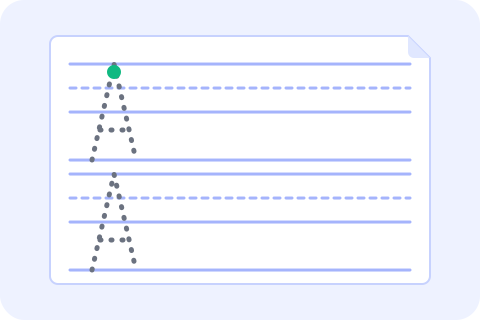
- Remind children where to start. The green dot is a rough guide; follow the stroke order your school teaches.
- Use faint-grey guides instead of dots when a child traces too slowly or presses too hard.
- Print at actual size so the four lines keep their proportions; do not use “fit to page” on a different paper size.
Handwriting practice on four-line paper
Learning to write letters is as much about size and position as about shape. These letter tracing worksheets use four-line handwriting paper: a top line, a dashed middle line, a baseline and a descender line, so children see where tall letters stop, where small letters sit and where the tails of g, j, p, q and y go. Choose any letters from A to Z, uppercase, lowercase or both, and each gets a solid model, dotted copies to trace and room to write on its own.
You can add a simple word for each letter, such as apple for A, and pick dotted, dashed, outline or faint guides depending on how much support the child needs. The font has single-story a and g, the shapes children are taught to write, instead of the printed double-story forms. Sheets can be made for A4 or US Letter, with lines in the header for the school, name, class and date. Combine them with the Arabic letter tracing sheets for bilingual classrooms, practise recognition with flashcards, and add maths with the math worksheets.
Looking for a calm way to make practice routine? See how to teach Arabic letters at home, where the same short-session approach works for English letters.
Step-by-step guides
Frequently asked questions
What do the four lines mean?
The top line is the height of capitals and tall letters. The dashed middle line is the height of small letters. Letters sit on the baseline, and g, j, p, q and y hang below it.
Can I print both uppercase and lowercase?
Yes. Each letter gets an uppercase row, a lowercase row and, if you like, a word row.
Is there a US Letter version?
Yes. English sheets can be made for A4 or US Letter paper from the page options.
Which font is used?
Andika, a typeface designed for reading and writing instruction with single-story a and g. It is released under an open license.
Are the names I type uploaded anywhere?
No. The sheet is drawn in your browser and nothing is sent to a server.